

NEX-22
Monthly and Quarterly GPL-1 Analogues for Treatment of Type 2 Diabetes and Obesity
Controlled release for fewer injections
NEX-22 is Nanexa’s long-acting GLP-1 programme based on PharmaShell®. Following clinical proof of concept with once-monthly liraglutide, Nanexa changed focus to semaglutide to pursue monthly and potentially quarterly dosing with a smoother pharmacokinetic profile.
From liraglutide to semaglutide
The NEX-22 project started with evaluating PharmaShell® for liraglutide, a GLP-1 marketed for daily administration.
The completed Phase 1 study provided clinical proof of concept: a single subcutaneous dose was shown to maintain liraglutide exposure over 36 days, with dose-linearity in exposure and Cmax. The clinical study generated important human data on release behaviour, safety and tolerability.
Building on these results, Nanexa switched development focus from liraglutide to semaglutide. The liraglutide results created the clinical and modelling foundation used to refine PharmaShell® coatings, improving formulation strategy and accelerating development also of long-acting semaglutide.
Project Transition
Liraglutide established clinical proof of concept. Semaglutide is now the GLP-1 in focus currently in preclinical development. The target is a differentiated long-acting GLP-1 analogue product with once-monthly and potentially once-quarterly administration.
What is type 2 diabetes?
Type 2 diabetes is a metabolic disease in which the body has difficulty regulating the level of sugar in the blood, leading to high blood sugar.
The disease occurs mainly in upper middle age (>45 years), but incidence is increasing among younger people because of an increasingly sedentary lifestyle and unhealthy diet.
Common symptoms include fatigue, increased thirst and frequent urination. The symptoms are initially vague and can sometimes be hard to notice. Type 2 diabetes can cause several serious sequelae, such as kidney damage, impaired vision and heart disease. Treatment is therefore crucial, both for patients’ general health and well-being and for limiting associated costs for healthcare and society.
Presence/Occurence
Not everyone living with type 2 diabetes is diagnosed, and even fewer receive adequate treatment. In the seven major markets in the Western world, it is estimated that around 50 million people will be treated with pharmaceuticals in 2027(1), with an increase of 2–3% per year.
Type 2 diabetes is one of the most common diseases, and incidence is increasing rapidly with an ageing population. Datamonitor Healthcare estimates that approximately 600 million people worldwide are living with type 2 diabetes today, a number estimated to increase to 635 million by 2027(2).
The treatment goal for type 2 diabetes is a lower blood sugar level. Lifestyle changes in eating habits and exercise are an important first step. A low-calorie diet and physical activity are key to lowering blood sugar levels.
Treatment
Several pharmaceuticals are available to treat type 2 diabetes. GLP-1 receptor agonists are an important class and are administered daily or weekly depending on the active substance and formulation. Semaglutide is currently marketed as a once-weekly subcutaneous treatment, while Nanexa’s programme aims to extend the dosing interval to once monthly or potentially once quarterly.
Market
Sales of pharmaceuticals for type 2 diabetes in the seven major markets in the Western world were estimated at approximately USD 50 billion in 2022. GLP-1 analogues accounted for approximately USD 15 billion and were expected to grow by around 10% per year during 2022–2029 (1).
Better compliance and more convenient treatment
Long-acting semaglutide
NEX-22 now focuses on PharmaShell®-coated semaglutide. The formulation is designed to release semaglutide in a controlled manner over an extended period, with the objective of maintaining therapeutically relevant exposure while reducing dosing frequency and avoiding pronounced concentration peaks.
Pharmacokinetic profile
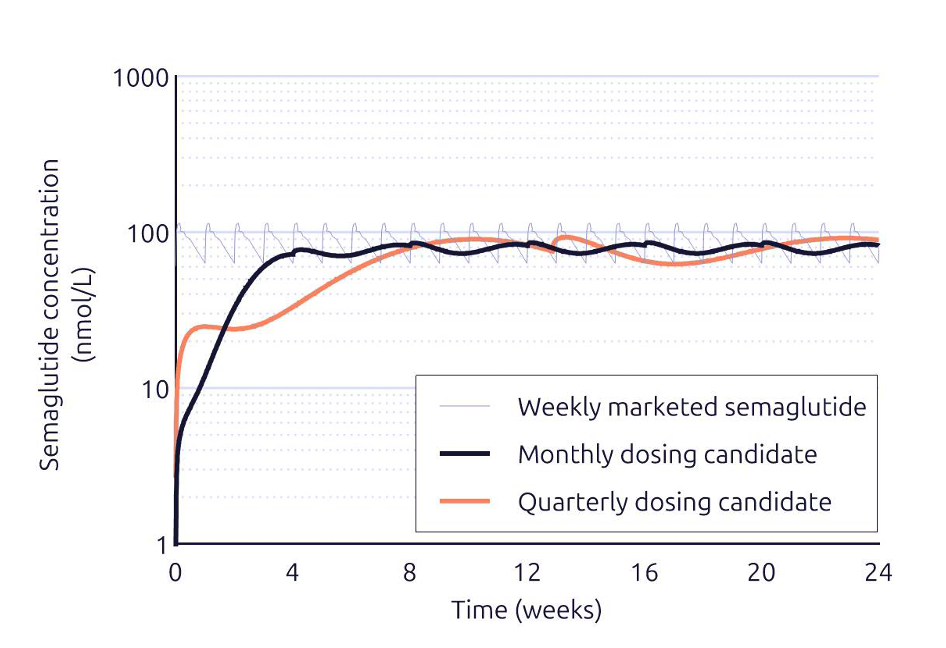
Preclinical semaglutide data and human simulations support smooth exposure profiles for extended dosing intervals with simulated peak-to-trough ratios of 1.2 for once-monthly dosing and 1.5 for once-quarterly dosing, compared with 1.8 for marketed once-weekly semaglutide. These modelled profiles support the programme objective of stable exposure with a low initial peak.
| Dosing profile | Dose | Peak-to-trough ratio |
| Marketed semaglutide, weekly | 2.4 mg | 1.8 |
| PharmaShell® semaglutide, monthly | 12.3 mg | 1.2 |
| PharmaShell® semaglutide, quarterly | 43.7 mg | 1.5 |
MONTHLY PK PROFILE
Simulated repeated dosing in humans: PharmaShell® semaglutide every 28 days
Stable exposure • peak-to-trough ratio 1.2
QUARTERLY PK PROFILE
Simulated repeated dosing in humans: PharmaShell® semaglutide every 90 days
Extended control • peak-to-trough ratio 1.5
Improving adherence through less frequent dosing
Long-term adherence remains a significant challenge in chronic GLP-1 therapy. Extending semaglutide dosing from once weekly to once every three months has the potential to substantially reduce treatment burden and improve treatment adherence. The programme aims to combine infrequent administration with controlled drug release and a low initial peak exposure, characteristics that may enhance tolerability, adherence and long-term treatment persistence.
Convenient
A long-acting semaglutide product could offer a differentiated alternative to current weekly treatments. PharmaShell® supports high drug loading, low injection volume and controlled release without changing the semaglutide molecule. The target product profile includes once-monthly or once-quarterly dosing, room-temperature storage potential and compatibility with patient-friendly injection devices.
(1) GlobalData, Type 2 Diabetes Forecast, 2021.
(2) Datamonitor, Type 2 Diabetes Disease Analysis, March 2021.